A few times a week, a man at our counter turns over the cuff of a white shirt, finds the ticket, and asks the question he has been carrying since he walked in: what actually makes this a quality dress shirt, and how is it different from the one the mall sells for seventy dollars? It is the right question, and it deserves a real answer. Montreal offices have gone largely tie-optional, which means the shirt is doing more of the talking than it has in decades — and a price north of three hundred dollars deserves a better defence than a logo. So here is the anatomy, part by part. Including the honest part, which is when the money is wasted.
A quality dress shirt starts in the yarn
Most of what you are paying for was decided before the cloth ever met scissors. Fine shirting begins with extra-long staple cotton — fibres long enough to spin into a yarn that is thin, strong, and smooth at the same time. The better mills then twist two of those yarns together into one thread. Two-ply, in the trade. The result is rounder, tougher, and carries a quiet lustre instead of a shine.
The seventy-dollar shirt is built the other way around: shorter fibres, a single yarn, and a surface brushed to feel soft on the day you buy it. It is soft that day. By the twentieth wash it has thinned at the collar and gone fuzzy at the cuff, and no ironing board can bring it back. The two-ply shirt, washed the same twenty times, is just getting comfortable.
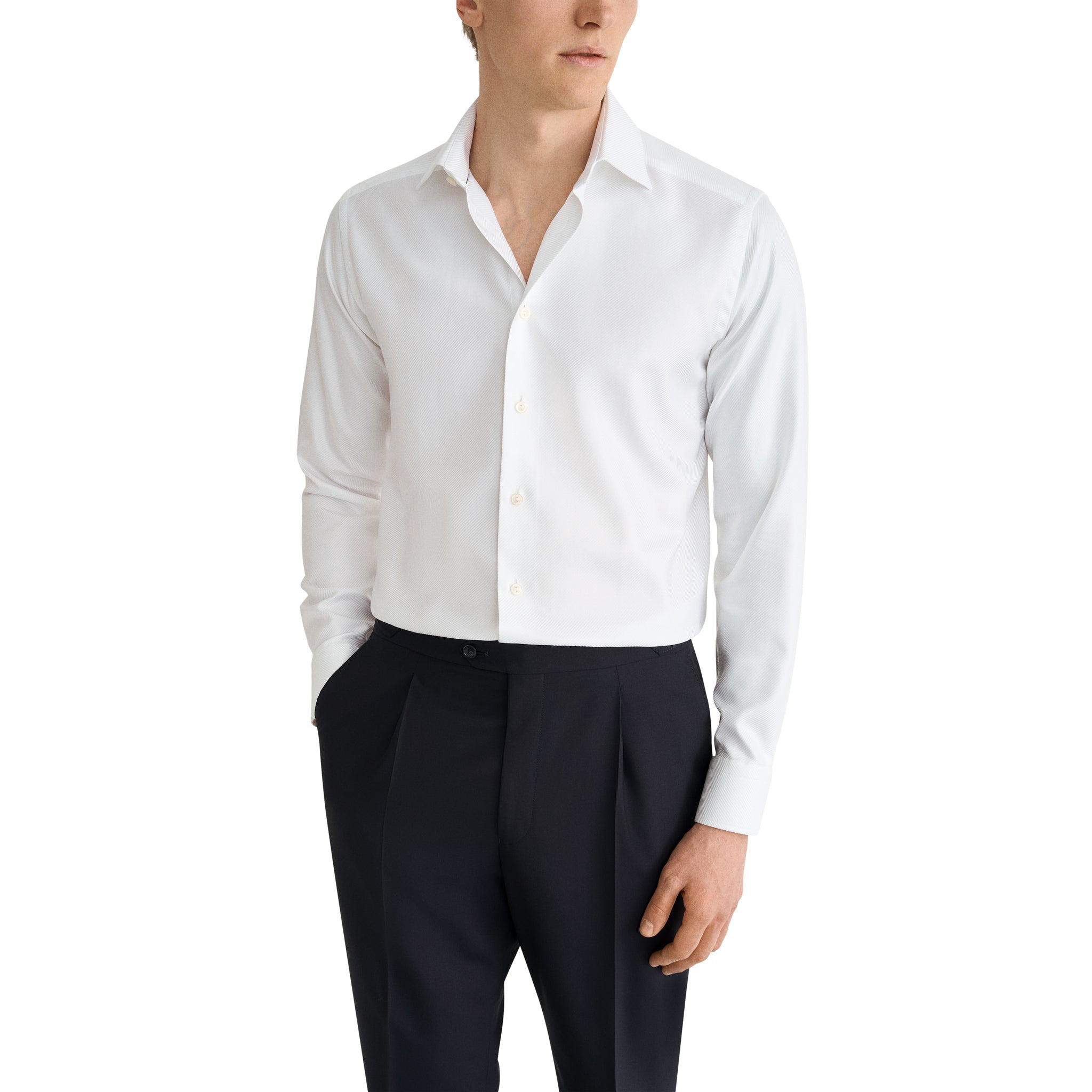
The clearest example on our wall right now is ETON's white King Twill — $350, woven from two-ply Filo di Scozia cotton, a thread prized for exactly that combination of strength and light. ETON calls King Twill its most iconic fabric, and we don't argue. It is what most men mean when they say a shirt looks expensive and can't explain why.
The collar does the acting
Cloth is half the price. The collar is most of the performance. In a tie-optional city the collar has to stand open on its own — we made that case in our shirt guide this fall, and November has not softened our view. Whether it stands is decided inside, where a proper collar is cut and shaped to hold its line through years of laundering. A cheap collar announces itself within a season: it bubbles, it curls, it lies down on the job. You can replace a button. You cannot resuscitate a collar.
Then come the details nobody photographs. Seams sewn dense and flat, so they lie quiet after washing instead of puckering into little ridges. Buttons cut from mother-of-pearl rather than moulded from plastic — colder to the touch, and far harder to crack. ETON's light blue semi-solid Signature Twill ($280) carries both: a three-tone weave that reads as texture across a desk, and mother-of-pearl holding it closed. Stenströms does the same work in its lavender check twill at $350, two sizes of seriousness from a country that treats the dress shirt the way Italy treats the suit. It is no accident that both shirtmakers we lean on hardest are Swedish.
When not to spend the money
Now the part a store is not supposed to say. If your shirt lives under a crew neck from October to April, most of this anatomy is invisible — the yarn unseen, the collar doing no acting. Buy the honest mid-range shirt and put the difference into the knit that actually faces the room.
And fit outranks fabric every single time. A $350 shirt in the wrong neck size is worth less than a seventy-dollar shirt in the right one; the man across the table can't see your thread count, but he can see a collar biting or a body billowing. This is why we measure before we sell, and why our tailors adjust shirts in-house — sleeves, body, collar — until the anatomy has a fit to live in.
But for the shirt at the front of the closet, worn weekly, the arithmetic turns kind. These shirts machine wash at home — no dry cleaner's ransom — press easily, resist wrinkles through a long day, and hold their collar for years rather than seasons. Fifty wears a year for five years puts the King Twill under a dollar and a half a wear. The mall shirt gets replaced three times over the same stretch, and looks like a replacement each time.
Bring in the one that let you down
The fastest education in shirting takes ten seconds and costs nothing: bring your best shirt and the one that disappointed you, and hold the two cuffs side by side under the light at our counter. The difference is not subtle. Then try the real thing on, let us set the collar and the sleeve, and wear it into a Montreal November that is suddenly asking more of your shirts than your ties.
The dress shirt wall on Decarie is at full depth right now, in sizes that will not survive December intact. Book a fitting, or simply come in with that cuff question. We like answering it.