The first week of November is when Montreal stops negotiating. The bikes come off the streets, the terrasses are stacked and chained, and the sweater stops being a nice idea and becomes the working middle of everything a man wears. From now until April, good knitwear is on a five-month shift with almost no days off. Which is why this is the week we hear the question most, usually at the counter while we fold the sweater into its bag: how to care for wool sweaters so they still look right in year five. The honest answer is that you should do less than you think, and do it in a particular order.
Our founder would have approved of that answer. When Jacques left Mukachevo at thirteen to apprentice as a tailor, cloth was expensive and patience was free. Garments were brushed, aired, rested, and mended, and they were expected to outlive their first owner. Ninety-one years after he opened this store in 1935, that is still more or less our entire philosophy of garment care.
How to care for wool sweaters, rule one: wash less, air more
Wool is the rare fibre that cleans itself most of the way. It sheds odour and resists soil in a manner cotton never will, which is why a merino crew from our knitwear wall can be worn a half-dozen times between washes without anyone being the wiser. After a wear, lay it over the back of a chair overnight. Away from the radiator, please — forced heat is the enemy of every natural fibre in this city, and from November on it is drying out your knitwear just as efficiently as it is drying out your hands.
When a sweater does need washing, two or three times a season is plenty. Cool water, a capful of proper wool wash, a five-minute soak, a gentle squeeze. Never wring. Roll it in a towel, press the water out, and dry it flat. And we will say this plainly, because somebody should: stop sending your knitwear to the dry cleaner by default. Solvent strips the softness out of the fibre, and a cashmere crew that has been cleaned monthly for one winter feels like it has aged a decade. Save the cleaner for a real stain.
Rest it, fold it, never hang it
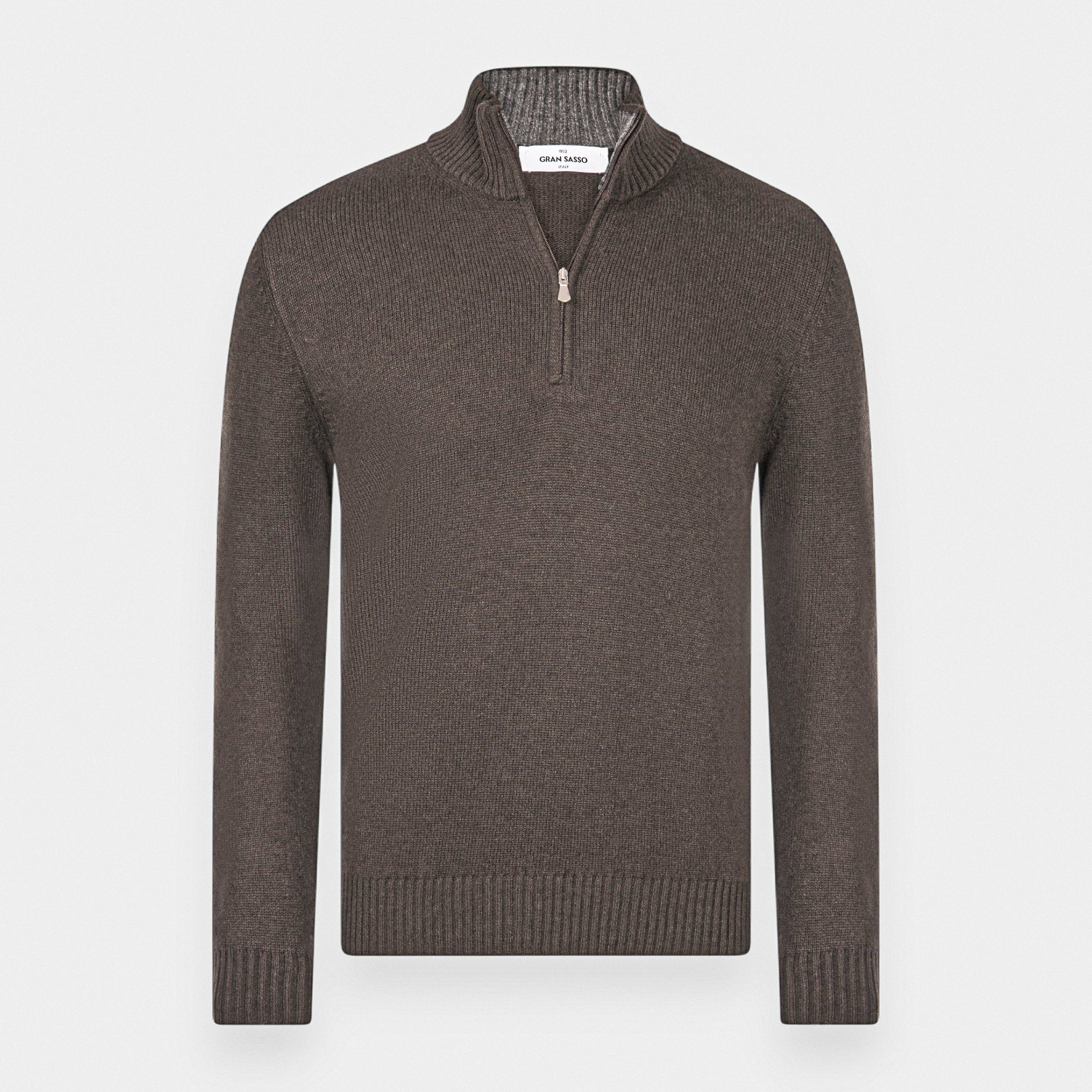
Wool has memory. Give a sweater twenty-four hours between wears and the fibres spring back to shape; wear it daily and they slowly surrender. This is the respectable argument for owning more than two good sweaters, and we make it without embarrassment: a rotation of three worn gently will outlast five worn in a panic. This fall that rotation might include a Gran Sasso crew in virgin wool — the Italian knitter is new to the store this season, and the handle convinced us in about four seconds — alongside something like a Phil Petter zip, knitted in Austria with a density you can feel the moment you pick it up.
Then there is the hanger question, which is not a question. A hanger carries the sweater's whole weight on two small points, and by February you have shoulders with horns and a hem somewhere near your knees. Fold your knitwear on a shelf, always. If the closet allows nothing else, fold it over the hanger bar the way you would a pair of trousers. Imperfect, but forgivable.
Pilling is friction, not failure
Every natural knit pills where it is rubbed: under the arms, at the hip where a bag strap sits, along the forearms of a man who spends his day at a desk. Cashmere pills early, sheds its loose fibre over the first few weeks, then settles down for years. A fine-gauge merino barely pills at all. None of this is a defect, whatever the internet tells you. Pass a sweater comb or a cashmere stone lightly over the surface once a month and the knit comes back like new. What you must not do is pull a pill off with your fingers — you draw good fibre out with it and invite a hole.
And catch holes small. A snag or a moth bite the size of a grain of rice is a quick fix; the same hole in March, after two months of wear, may not be. Our alterations department sees sweaters all winter, and the early arrivals almost always leave happy.
April is the dangerous month
The hard part of the knitwear year is not the wearing — it is the putting away. Moths are drawn less to wool itself than to what a winter leaves on it: skin, dinner, the ghost of a cologne. A sweater stored clean is of very little interest to them. So before anything goes into a drawer for the summer, wash it, fold it into a breathable cotton bag — never plastic, which traps the humidity of a Montreal July against the fibre — and add cedar you have freshened with a pass of sandpaper. Do this in April and September will smell like a forest. Skip it and September may cost you your favourite sweater.
If you would rather talk any of this over with the garment in hand, that is precisely what we are here for. Come see what has landed among the new fall arrivals, or book an appointment and bring the sweater with the snag. We have been keeping Montreal's wool alive since 1935. Yours will not frighten us.