Twice this fall, the same garment arrived at 6224 Decarie from two houses that agree on very little: a Swedish shirtmaker and a tailoring family from Mantua. Both sent a bomber. Both cut it from wool flannel — suit cloth, from suit mills. Since then we have watched men circle the wool bomber jacket, lift a sleeve, and ask the same question in different words: am I allowed? You are. What follows is the case for it, and the fine print we would rather you hear across our counter than discover at home.
The bomber’s reputation problem
The bomber began as flight equipment, and for most of the decades since it has dressed the part: nylon shell, a lining in some shade of emergency orange, a zip that sounds like a tent. It was worn by men half our clients’ age, usually over a hoodie, and the men who read these pages quite reasonably filed it under not for me.
The silhouette was never the problem. A jacket that ends at the waist, closes with a zip and finishes in a shirt-style collar is a genuinely useful shape — trim enough to drive in, warm enough for the heated-garage stretch of a Montreal November, and finished enough for any office that has stopped requiring a lapel. The materials were the problem. This season, the materials changed.
What a wool bomber jacket changes
Hand the pattern to a mill that weaves suiting and the garment changes category. We have made this argument in these pages all fall: at ten feet, texture is what reads. A nylon bomber reads as equipment. A milled flannel one reads as clothing — closer kin to the sport jacket it stands in for than to the flight jacket it is named after.
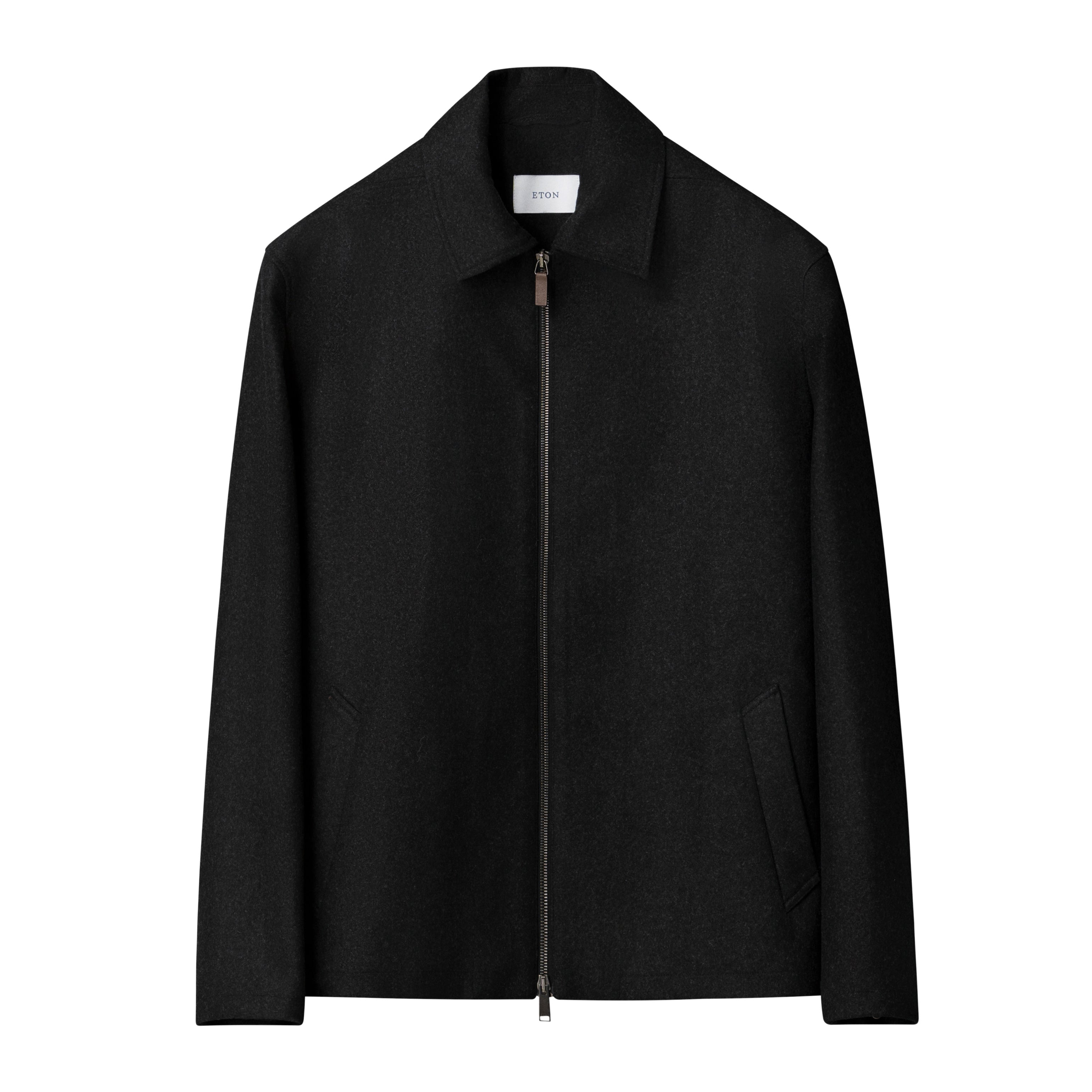
ETON’s version makes the point plainly. The dark charcoal wool Harrington bomber ($750) is cut from flannel woven in Italy by Marzotto — the same order of cloth you would expect on our tailored wall — with a shirt-style collar, a two-way zip, a lightly lined front and a slightly shorter, modern length. It is what happens when a shirtmaker designs outerwear: everything is quieter than it needs to be and better finished than it has to be. Zipped to the sternum over a white shirt or a fine gray knit, it does the Harrington’s old job at offices the Harrington never met.
The Mantua answer is the Luigi Bianchi full-zip bomber ($1,575) in Vitale Barberis Canonico flannel, a gray with a distinct olive undertone — the thinking man’s charcoal, gray under boardroom light and faintly green in a November street. Patch pockets, fully lined, made in Italy. We made the case for Mantua’s hand in these pages last month; this is that hand, off duty. It hangs on our wall in exactly two sizes as we write — a 40 and a 42 — which is not a sales tactic, only how small Italian programs ship.
How to wear it, and why the fit is final
The rules are short. Underneath: a fine-gauge knit or a proper collar, never a hoodie — the cloth promoted this jacket, and the layer beneath can demote it just as quickly. Below: a bomber ends at the waistband, which puts your trousers in the foreground all day. Gray flannel trousers are the natural partner; dark denim works under the usual conditions — dark, uniform, nothing distressed. Suede derbies, dark loafers or a plain leather sneaker finish it.
Now the fine print. A bomber hands our tailors almost nothing to work with. Elastic hems, snap cuffs and zip fronts carry no seam allowance; there is no letting out, no taking in, no rescue. The mirror decides, and it decides at the moment of purchase. The ETON is a regular fit and behaves like one. The Luigi Bianchi is generously cut — the house itself suggests dropping a full size for a trimmer line, and we agree. This is precisely the garment to buy standing in front of us, wearing the sweater it will live over.
The November arithmetic
For another few weeks, a flannel bomber is the coat — mid-November still grants the odd jacket-is-the-coat day. From December to March it moves indoors and becomes the jacket you simply never take off: worn through the office, kept on at dinner, correct in both rooms. A garment that works seven months a year at the price of a good sport jacket is not an indulgence. It is arithmetic.
Both pieces are in our new fall arrivals, hanging a few steps from the tailored wall they answer to. Try the two side by side: the cloth makes one argument, the price makes another, and the mirror referees. Book an appointment or take your chances with the door on Decarie. Either way, the flight deck can keep the nylon. The flannel stays with us.