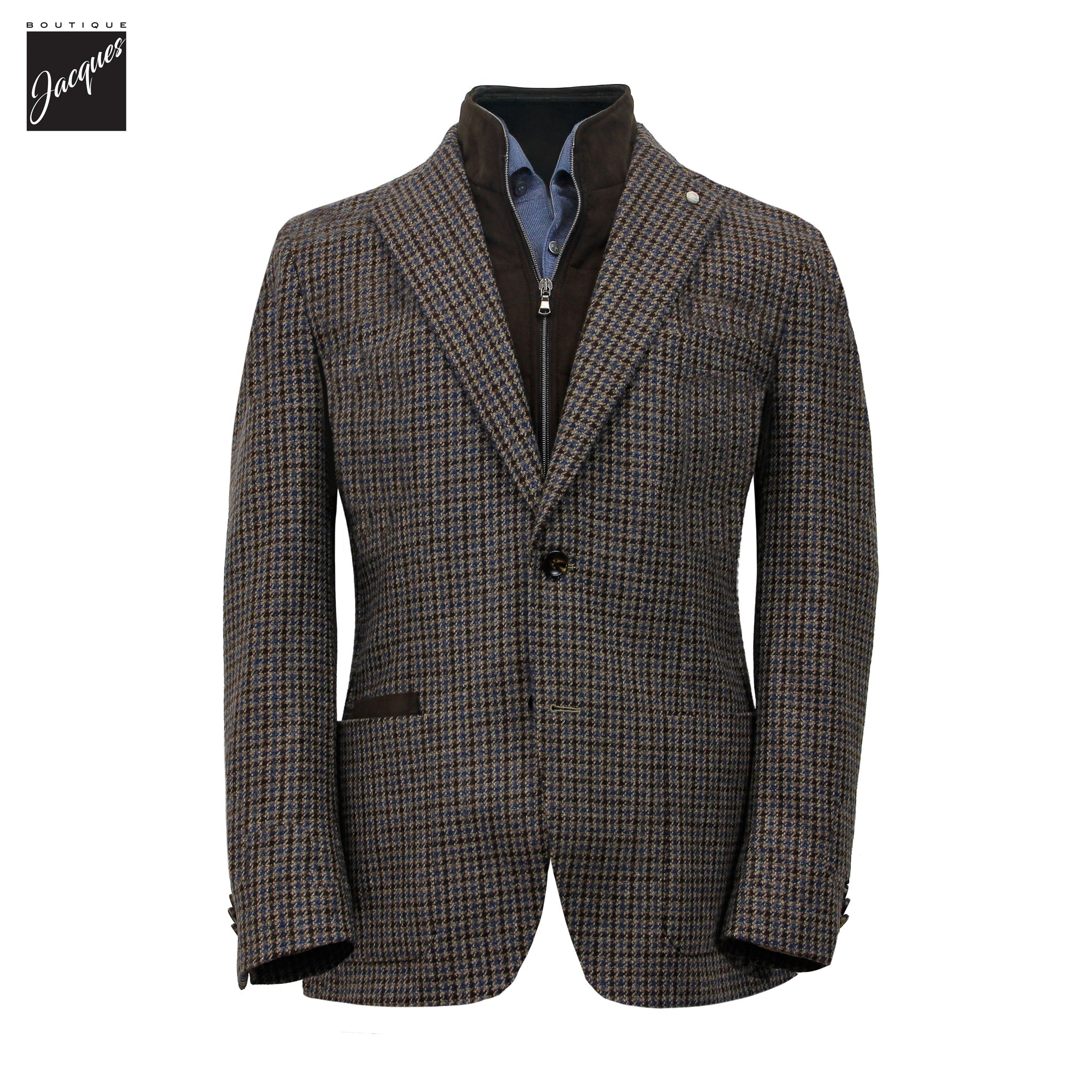
The question almost never gets asked out loud. A man stands in our fitting room on Decarie Boulevard with a houndstooth jacket on his shoulders, likes what the mirror is telling him, and then hesitates at the obvious next step: what does he wear with it? How to mix patterns is the dressing question most men solve by avoidance — a closet of solids, nothing clashing because nothing is saying anything. It works, the way silence works. But we have spent this fall watching checked jackets and striped shirts leave the store together, and we can tell you the rules are fewer, and more mechanical, than the fear suggests.
Three rules, really. Scale, colour, and knowing when to stop.
How to mix patterns: scale decides almost everything
Never wear two patterns at the same scale. That one rule prevents nearly every disaster we have seen walk past the fitting-room mirror. The eye wants a hierarchy — one pattern speaking, the other murmuring. Take the boldest jacket on our wall this season, the brown and blue houndstooth wool-cashmere sport jacket from Luigi Bianchi Mantova ($1,595), a check you can read from across a boardroom. Under it, a stripe so fine it nearly vanishes: ETON’s blue stripe Signature Oxford ($280) does exactly this job. From the far side of the table the shirt reads as nearly solid; at hand-shaking distance it comes alive. The logic reverses just as well — a bolder stripe wants a quieter, smaller check above it. What fails is equality. Two patterns of the same size argue like brothers in the back seat, and everyone nearby wishes they would stop.
The second rule: the patterns must share a colour. That houndstooth carries a blue thread through its weave; the stripe below picks it up, and suddenly two patterns look like one decision instead of two accidents. We have argued all season that brown is where this fall lives, and here is where the argument earns its keep — brown and blue is the easiest pattern marriage in menswear, the brown warming the blue, the blue steadying the brown. If you cannot name the colour your two patterns have in common, they do not have one. Change the shirt.
Texture counts as a pattern
This is the part most guides miss. A grenadine weave, a flannel, a hopsack — cloth with real surface occupies a pattern slot without competing for it. ETON’s brown striped grenadine silk tie ($230) is the idea in miniature: the open, almost crunchy weave does half the talking and the stripe does the rest, neither raising its voice. Gray flannel trousers under a checked jacket are not a solid, whatever the swatch book says; they are a texture, and they count. We have made this case before about low restaurant light and boardrooms — texture reads across a room. It also fills out an outfit that would otherwise need a third print.
Which brings us to stopping. Two patterns and one texture is the ceiling for daylight hours, and most days you will not need the ceiling. When in doubt, remove one. No man was ever remembered as badly dressed for wearing one pattern too few; a few are remembered, vividly and for years, for one too many.
The microcheck is the way in
If a blanket-scale houndstooth feels like a leap, start smaller. Corneliani’s brown and blue mini check wool sport jacket ($1,798) is the gateway garment: at ten feet it reads as texture, at arm’s length it resolves into pattern. You get the depth without the announcement, and every solid shirt you own already works with it. A patterned suit operates the same way — a Prince of Wales check is one decision, made once, not a negotiation you restage every morning.
And mid-October is precisely the moment. Summer is for solids; linen has enough to do just surviving the humidity. Fall cloth — flannel, wool-cashmere, brushed cotton — has the depth to carry a check properly, and by four o’clock the Montreal light comes in low and sideways and wants something to catch. The gray months ahead will be long. Give them something to look at.
If you are unsure, settle it the way everything gets settled here: in front of the mirror. Bring the shirt you mean to wear, try the jacket over it, and we will tell you honestly when it sings and when it is one pattern too many — then our tailors will handle the sleeves while you decide. Book a visit, or simply come by the store. The mirror has never once lost this argument.