Cart
0
We have spent most of this month writing about tailoring — how many suits a man needs, what a tailor can fix, how to keep the dry cleaner from ruining good cloth. Time to look down. Knowing how to choose dress shoes is the least discussed skill in a professional wardrobe and the most visible when it is missing. A two-thousand-dollar suit over collapsed, dried-out shoes reads as tired, full stop. The reverse is also true: a good pair of shoes will carry an otherwise ordinary outfit through a full day of meetings. On our floor on Decarie Boulevard we can usually tell who takes his wardrobe seriously before he says a word, because the answer is on his feet.
Start with the life you actually lead
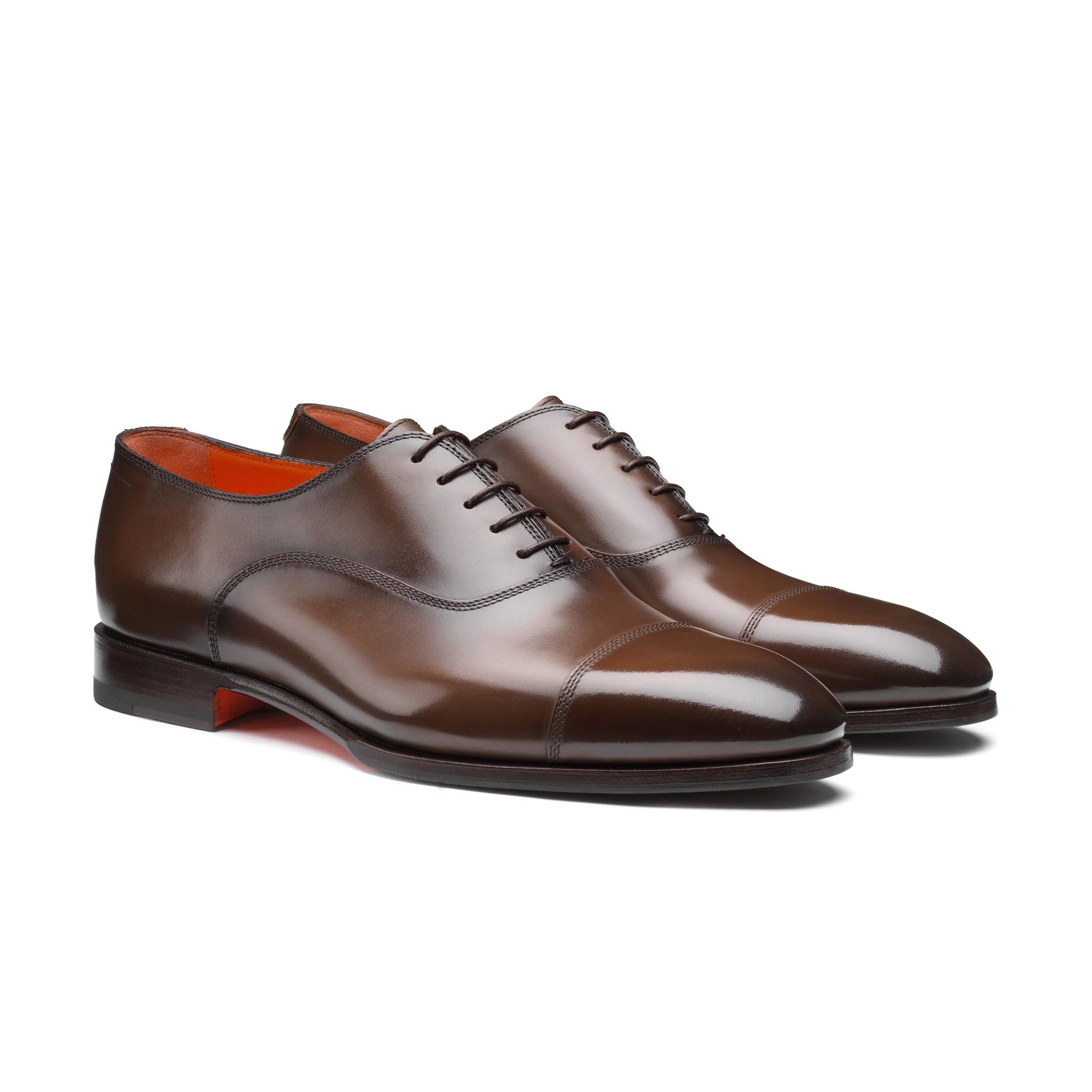
The traditional answer is that a man's first dress shoe should be a black cap-toe oxford, and if your weeks are spent in a dark suit in front of clients, the traditional answer is still correct. Closed lacing, a plain cap, no broguing, no hardware. It is the one shoe that is never wrong with a suit, which is why the Santoni Archie — a cap-toe cut from hand-finished calfskin in the Marche region — sits at the front of our shoe wall every fall.
But most Montreal offices went tie-optional years ago, and our advice has moved with them. If you wear a full suit twice a week and sport jackets the rest of the time, buy dark brown before you buy a second black pair. Brown works with navy, with gray flannel, with every tweed and check we brought in this season; black works with dark suits and evenings. We stock the Archie in both colours, and for every black pair we fit, we sell three brown. That ratio is not an accident. It is how this city dresses now.
The other decision is oxford or derby, and here fit should outrank fashion. A derby's open lacing gives the instep room to breathe, which is why men with higher insteps or wider feet find oxfords punishing and derbies comfortable from the first wear. There is no shame in it. A tumbled-leather derby like the Magnanni Melich V will do everything short of black tie, and do it without complaint.
How to choose dress shoes that outlast the trend
Turn the shoe over and bend it gently. What you are paying for, at any serious price, is full-grain calfskin that creases instead of cracking, a leather insole that molds to your foot, and a sole attached by stitching rather than glue alone. A cemented shoe is disposable by design. A welted or Blake-stitched shoe — the construction our Italian and Spanish makers favour for its sleeker line — can be resoled two or three times, which changes the arithmetic entirely.
Between a $640 pair and a $1,350 pair, the differences are the grade of the hide, the hours of hand-finishing in the patina, and the refinement of the last. Those differences are real; we handle both every day. But we will say plainly what the price tag will not: one excellent pair, resoled at year four, will outlive and outdress three cheap pairs bought over the same stretch — and cost about the same. Buy fewer, buy better, wear them for a decade.
The number inside the shoe is a suggestion
No measurement matters more than the widest part of your foot sitting exactly in the widest part of the shoe. Every maker builds on a different last, so a 9 in one house is an 8.5 in another, and a man who insists on "his" size will end up fighting his shoes. Calfskin gives a little in width over the first weeks. It never gives in length. If your toes touch, the shoe is too small today and will be too small in five years. A whisper of heel slip in a new oxford, on the other hand, usually disappears as the sole breaks in. Come in the afternoon, when your feet are at their true size, and let us bring you three lasts instead of three sizes. Our dress shoe wall holds Magnanni, Santoni and friends precisely so you can feel the difference between them in one sitting.
A word about our sidewalks
Choosing shoes in Montreal means choosing for November, not just for September. A leather sole is elegant and quiet; it is also a skate on the first icy morning on Côte-des-Neiges. For the pair you will wear daily through winter, ask us for a rubber-soled model or have our cobbler add a thin protective rubber sole to a leather one — it costs little and takes nothing from the line of the shoe. Suede is fair game for fall, provided it is waterproofed before the first wear; we wrote about the full September care routine earlier this month, so we will only repeat the rule that matters most: never wear the same pair two days running.
The best way to learn all of this is with shoes on your feet and a mirror in front of you. Book a visit, or simply walk in — we will size both feet, because they are never quite the same, and send you out the door standing a little taller.