Chariot
0
Let us say this plainly before we go any further: we do not sell watches. There is no glass case at the back of the store on Decarie Boulevard, and there are no plans for one. But if you want to know how to wear a watch with a suit, we would gently suggest you ask a tailor before you ask a jeweler. Every week at our bench, sleeves are hemmed around watches. The watch on your wrist decides where your shirt cuff ends, how your jacket sleeve falls, and — more than most men realize — what the rest of the table concludes about you before you have said a word.
So here are our rules. They come from the fitting room, not the showcase.
How to wear a watch with a suit: the cuff decides
Start with the geometry. A jacket sleeve should end so that a quarter to half an inch of shirt cuff shows when your arm hangs at your side. The watch lives under the shirt cuff — not over it, not crowding out beneath it. Standing, arm down: covered. Reach across the table to sign something: there it is. That brief appearance at the moment of the signature is the entire performance, and it is enough. A watch that sits fully exposed below the cuff all day means the sleeve is too short or the watch is too big. In our experience it is usually the watch.
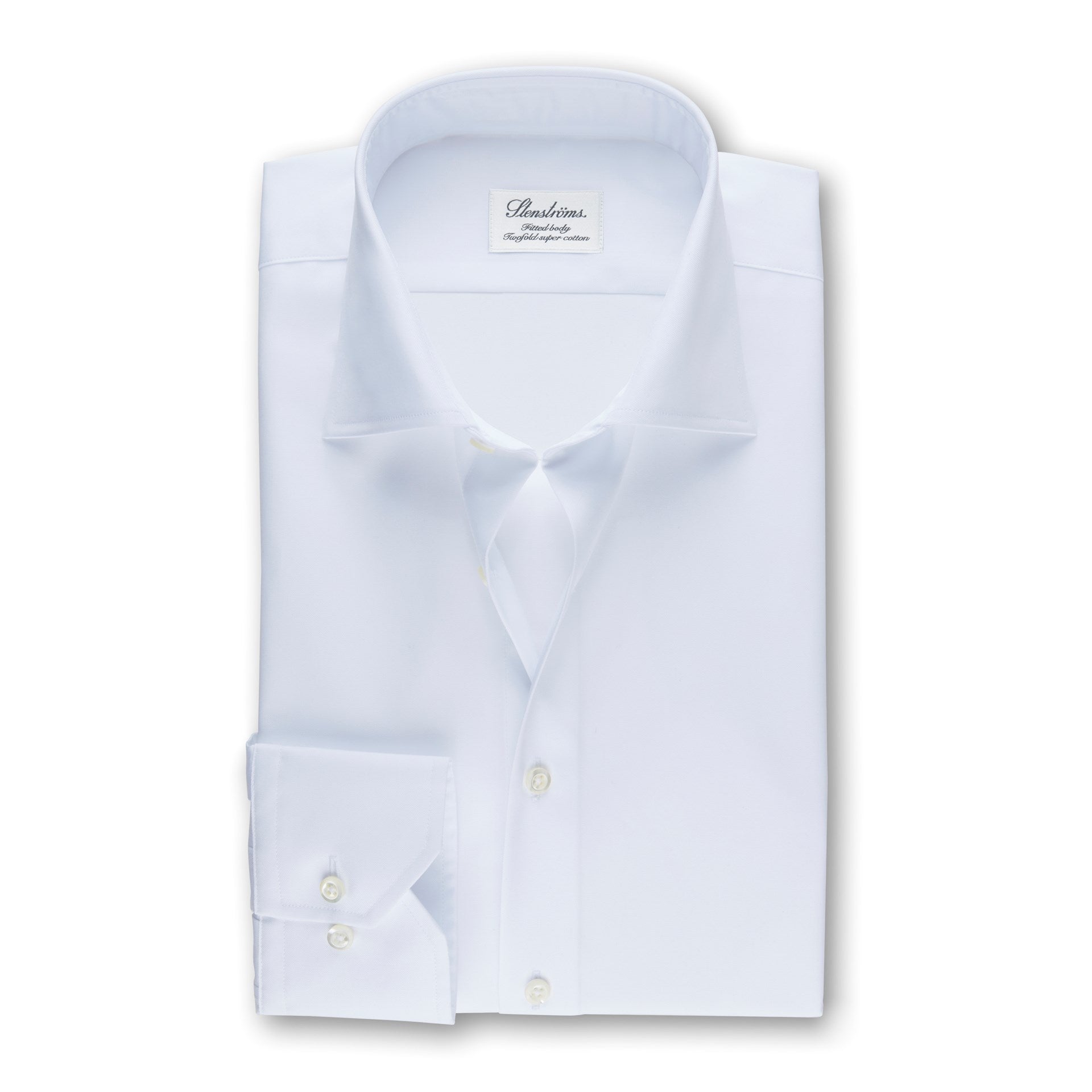
This is why our tailors ask two questions before touching a sleeve: which wrist, and which watch. A slim dress watch slides under any well-made cuff. Something more substantial needs the left cuff cut a touch wider than the right — a detail we build into made-to-measure shirts as a matter of course, and can often manage in alterations on a shirt you already own. A properly cut ready-made shirt, like Stenströms' white fitted body shirt in Superior Twill, leaves honest room for a watch of reasonable height. If your watch fights the cuff every time you check the time, the answer is not a looser shirt.
Which brings us to an opinion we will defend at the counter: a thick diver under a dress cuff is hiking boots with a suit. Capable, admirable, wrong room. Wear it on the weekend, where it belongs.
Thin wins the boardroom
Dress Montreal's executives for long enough and a pattern becomes hard to ignore: the most senior man in the room is rarely wearing the loudest watch. The statement piece — big case, busy dial, a bezel doing several jobs — tends to sit further down the table. The corner office wears something thin, often older than his suit, on a plain leather strap, and checks it once. Quiet confidence is a phrase we generally distrust, but there is no better description of a slim, time-only watch under a crisp cuff.
A watch in a meeting works the way a suit does: it should raise no questions it cannot answer gracefully. An heirloom answers gracefully. So does an honest, modest watch bought with a first bonus. What answers awkwardly is anything chosen to be noticed from across the room.
And yes — Gianni Agnelli famously wore his watch over the shirt cuff. He also controlled Fiat. Privileges available to the man who owns the company are not a system for the rest of us.
Match the leather, mind the flash
The old rule still earns its keep: black strap with black shoes, brown strap with brown. On a day that calls for black cap-toes and a navy suit, a tan strap looks like it dressed for a different appointment. A steel bracelet is neutral with either, though a mirror-polished one can throw more light across a boardroom table than you intended. Brushed finishes behave better.
We will add that our fall tailoring leans brown this season — tobacco checks, chocolate flannels — and we have been recommending brown shoes over a second black pair for tie-optional offices for a while now. A good brown strap belongs in that same conversation. One watch with two straps, black and brown, covers a working wardrobe more gracefully than two watches.
A practical Montreal note, while we are here: from December through March the whole question disappears under a glove and a coat sleeve. At minus fifteen, nobody on Decarie sees your watch. The shirt cuff does the public speaking for much of the year — one more argument for spending on good shirts before spending on straps.
Bring the watch to the fitting
The most useful advice in this post is also the simplest: when you come in for a suit or a made-to-measure fitting, wear the watch you actually wear — not the bare wrist of a man who dressed in a hurry. We hem sleeves to the life you live in them. A jacket sleeve set against a bare wrist in September is a sleeve you will be tugging at by October, and a shirt cuff measured without the watch is a cuff that will spend the winter riding up your forearm.
Book a fitting, bring the watch, and we will make the suit, the shirt, and the wristwatch behave as if they had been properly introduced. We may not sell the watch — but we can make sure everything around it fits.