Nous avons vu un homme délibérer entre deux vestes marine presque identiques pendant près d'une heure, puis choisir son pantalon dans le temps qu'il nous a fallu pour replier la première. Cela arrive chaque semaine, et les priorités sont exactement à l'envers. Pensez au déroulement réel d'une journée de travail : la veste est sur le dossier de la chaise dès neuf heures et demie, et ce que la pièce voit à partir de là, c'est la chemise et le pantalon. Savoir choisir un pantalon habillé est la compétence la moins glamour de la mode masculine et l'une des plus précieuses — et avec les premiers matins frais qui s'installent sur le boulevard Décarie, c'est la semaine pour l'acquérir.
Commencez par la hauteur de taille, pas par le tour de taille
La hauteur de taille — la distance entre la ceinture et la couture de l'entrejambe — détermine davantage l'allure d'un pantalon que toute autre mesure, et c'est la seule que personne ne vérifie. Vingt ans de mode taille basse ont habitué les hommes à porter leur pantalon sur les hanches, où la ceinture s'enfonce dès que vous vous assoyez, où la chemise se défait et où la jambe s'effondre sur la chaussure. Un vrai pantalon habillé se porte à la taille naturelle ou près de celle-ci, de sorte que le tissu tombe en une seule ligne nette de la ceinture à l'ourlet. Cela semble démodé pendant environ une journée. Puis vous traversez une réunion de deux heures dans le confort, et le débat est clos.
La deuxième règle : achetez pour le siège et la cuisse, jamais pour la taille. Notre atelier peut reprendre une ceinture ou fuseler une jambe en un après-midi; personne ne peut ajouter du tissu qui n'existe pas. Si le siège tire quand vous vous levez, le pantalon a échoué, peu importe l'étiquette. D'après notre expérience, la plupart des hommes portent leur pantalon une taille trop ajustée et une cassure trop longue, et corriger les deux ne coûte rien de plus qu'un essayage bien fait.
Ici, c'est le pays de la flanelle
Un pantalon en laine peignée lisse est correct douze mois par année. Mais le calendrier montréalais vous offre sept mois pendant lesquels il existe une meilleure réponse. La flanelle est une laine brossée jusqu'à obtenir un duvet doux : elle retient la chaleur sans le poids, drape au lieu de coller, et reste mate là où le peigné brille. Sous une veste sport, ou avec rien de plus qu'une maille fine, elle a l'allure de la saison elle-même.
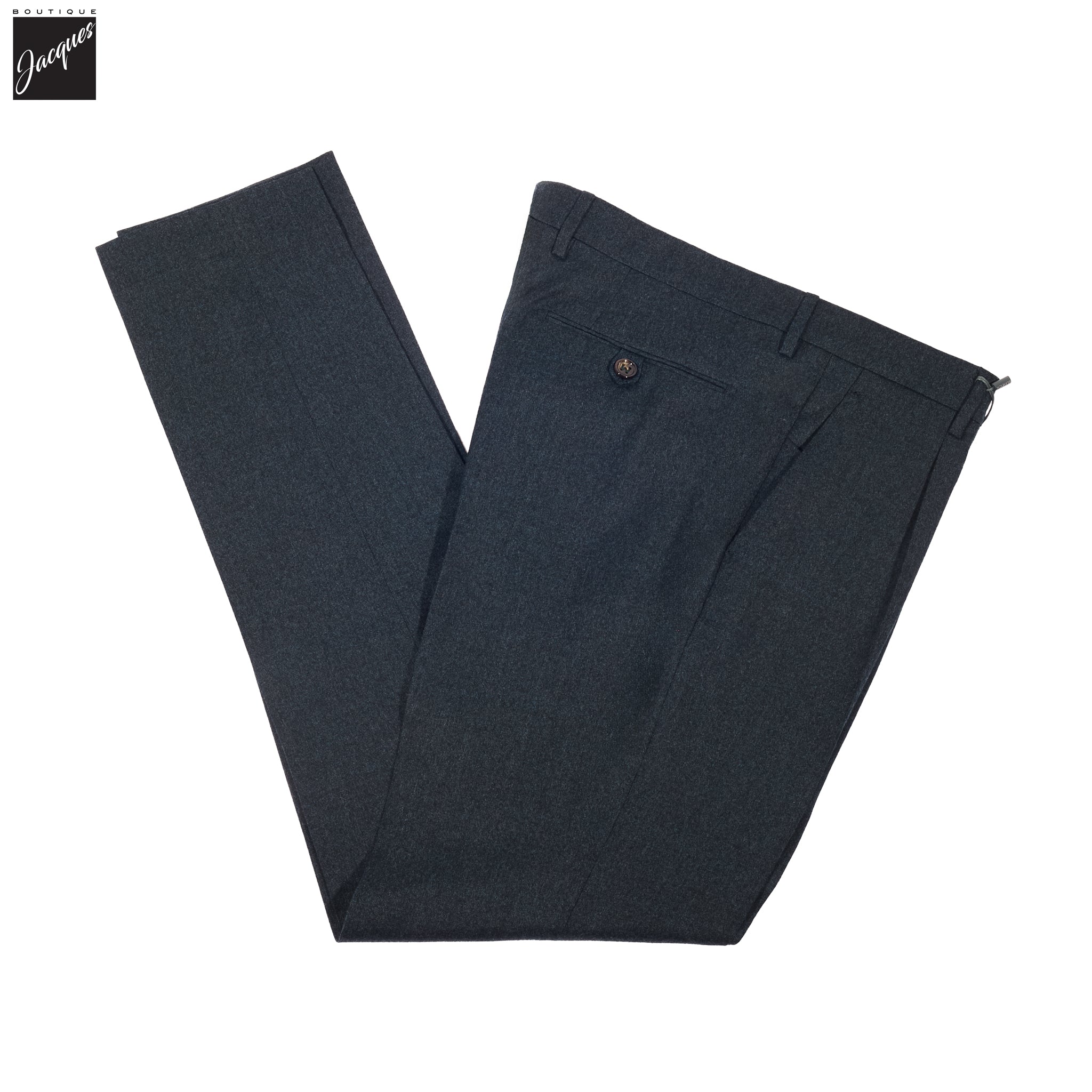
La paire par laquelle nous commencerions est le Morello en flanelle marine chinée de Berwich — coupé en Italie avec un seul pli et une hauteur de taille sensée, le genre de pantalon qui rend tout ce qui se porte au-dessus plus réfléchi. Un cran plus haut, les flanelles en laine et cachemire de Marco Pescarolo sont, tout simplement, les plus beaux pantalons de la boutique; les clients qui essaient le cinq-poches en flanelle brune ont tendance à arrêter de chercher ensuite. Les deux sont sur les présentoirs en ce moment, aux côtés du reste de nos pantalons habillés pour l'automne.
Côté couleur, notre conseil n'a pas changé depuis des décennies : gris moyen et marine d'abord. Un pantalon de flanelle grise s'accorde avec toutes les vestes que vous possédez, et c'est précisément pourquoi il ne donne jamais l'impression d'en faire trop.
Comment choisir un pantalon habillé quand votre bureau a abandonné le costume
La moitié de nos clients s'habillent désormais pour des bureaux qui se situent quelque part entre le tailleur et le décontracté, et la solution honnête est le pantalon cinq-poches : l'architecture du jean, exécutée dans un tissu habillé. Les cinq-poches Nerano de Marco Pescarolo en laine extensible marine passeront n'importe quel souper client en ville avec une maille et des mocassins, et auront encore la bonne allure à un dîner du samedi. Le cinq-poches Ceramica d'Alberto fait le même travail dans un tissu technique qui traverse les trajets quotidiens ou une semaine de voyage sans se froisser. Nous les gardons avec les pantalons décontractés, mais ne vous y trompez pas — ils font un travail de pantalon habillé.
L'ourlet est la poignée de main
Aussi beau soit le tissu, un pantalon se gagne ou se perd dans les dix derniers centimètres. Notre position : une seule cassure légère au maximum, et aucune si vous préférez les mocassins. Une flaque de tissu excédentaire à la cheville défait tout ce que le drapé avait accompli plus haut. Les revers ont leur place sur les flanelles à plis — ils ajoutent du poids exactement là où la flanelle en veut — et restent à l'écart des pantalons sans plis.
Chaque paire que nous vendons est ourlée dans notre propre atelier, et nous préférons que vous apportiez les chaussures que vous comptez réellement porter plutôt que de deviner. Si vos pantalons actuels n'ont jamais rencontré de tailleur, apportez-les aussi; il y en a plus de récupérables que vous ne le croyez. Prenez rendez-vous, et nous réglerons la hauteur de taille, la cassure et tout ce qu'il y a entre les deux.