Every autumn a particular kind of man walks into the shop on Decarie with his phone in his hand and an appointment he did not expect. The interview is Thursday. Sometimes it is tomorrow. And the question he asks quietly, once the small talk runs out, is the one this post answers: what to wear to a job interview. He is usually a little embarrassed to be asking. He should not be. It is one of the few questions in menswear with a date and a time attached.
Last month in these pages we covered dressing for the first day of a new job. This is the harder brief. On a first day you have already won; the clothes only have to keep quiet. At an interview you are still being read, and the reading begins in reception, before you have said a word.
What to wear to a job interview: start with the suit
If the industry you are entering wears suits — the banks, the firms, most of what happens in Old Montreal — the answer is a suit, worn with a tie, and there is nothing further to decide. Do not talk yourself into less because the posting said the culture is relaxed. The culture may be relaxed. The hiring decision is not.
If you genuinely cannot tell — a software firm in the Mile End, a startup above a café — wear the suit anyway, and build it to come down a step. We made this argument about ties earlier this month and it is doubly true on interview day: overdressed is a condition you can fix in the elevator; underdressed is the whole meeting. The tie rides in your coat pocket either way. You decide in the lobby, based on the first three people you see.
Colour is simple. Charcoal or dark navy, nothing else. Charcoal says you came to work; navy says the same thing with slightly better posture. Black is for evening — a position we have held in these pages all fall — and any pattern louder than a faint check gives the room something to remember that is not your answers. Our standing recommendations, the charcoal and dark navy Jack Victor Esprits, are cut fifteen minutes from our door, and we fit them weekly on men with Thursday deadlines.
The white shirt is a strategy, not a cliché
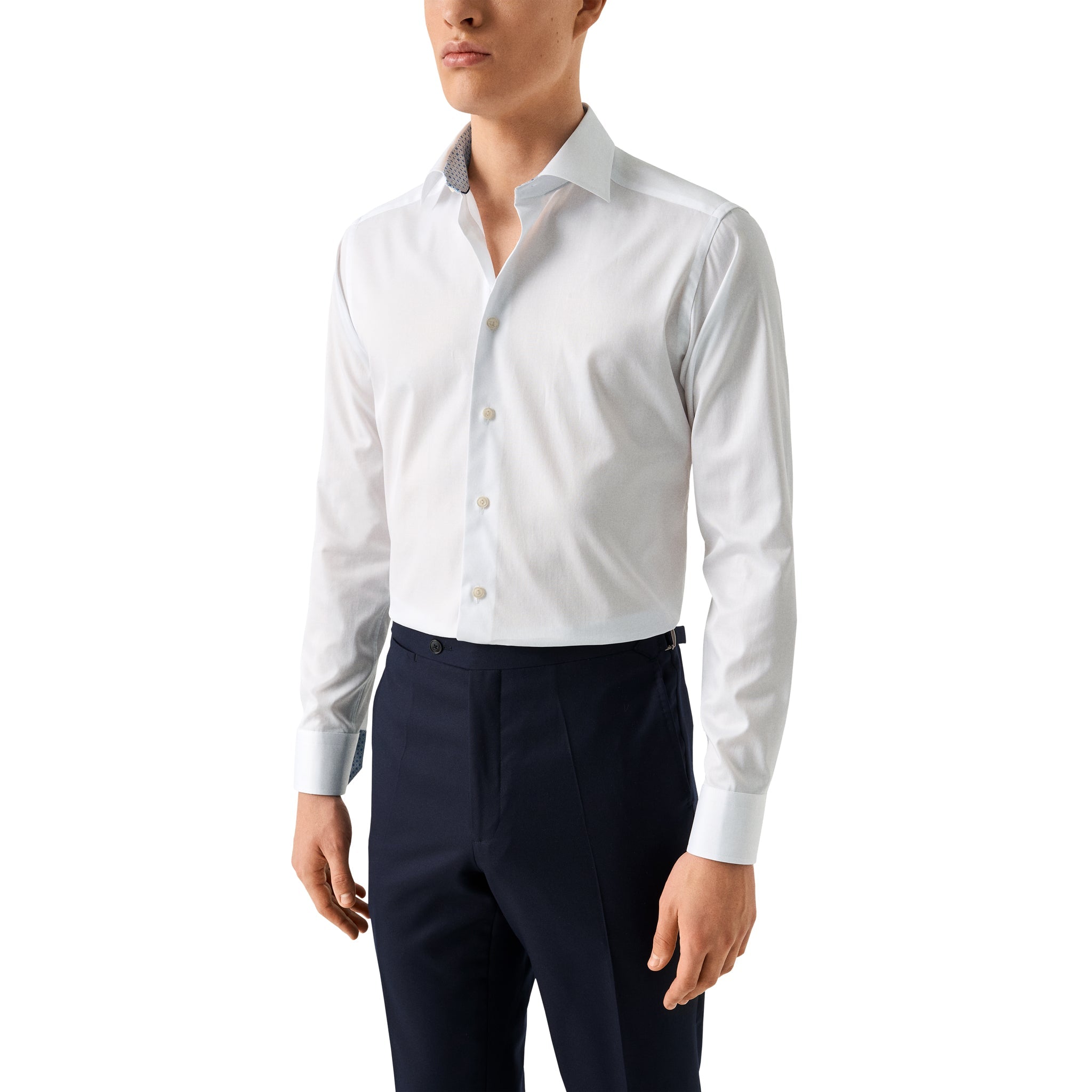
The interview shirt is white, for practical reasons rather than sentimental ones. White sits correctly under any dark suit you own. It reads as effort without reading as flair. And it does quiet optical work that a fluorescent meeting room will not do for you: it puts light under your face. We like ETON's white Signature Twill for exactly this job ($280) — a crisp cut-away collar that stands properly on its own if the tie stays in your pocket, and frames a four-in-hand if it comes out. Pressed, obviously. A wrinkled white shirt is worse than no effort, because it is visible effort that failed.
One honesty before Thursday: if your neck size has moved since the last time you bought a shirt — it happens to nearly everyone — this is the week to admit it. A collar that bites reads as discomfort, and the man across the desk cannot tell the difference between a tight collar and a weak answer.
The tie, if it comes out, is navy with a pattern smaller than a shirt button; the woven micro dot we recommended earlier this month is precisely right. Shoes are dark, plain, and polished the night before — not the week before. And nothing on your feet should be new that morning. Break shoes in the week prior or wear the pair you trust. An interview is the wrong day for a first anything.
In November, the coat walks in first
Here is the part the style guides written in warmer cities leave out: from November to April, the first thing a Montreal interviewer sees is not your suit. It is your coat — crossing the lobby, folded over your arm in reception, hung on the back of the door while you wait. The coat arrives before the handshake does.
A parka with a lift pass on the zipper will do that talking for you, and it will not say what you want said. Over a suit, the answer is a tailored overcoat, and the one we would send a candidate out in this season is Jack Victor's midnight blue Wesley ($1,298) — a wool-cashmere made in Italy, single-breasted with a notch lapel, soft through the shoulder so it lies over a suit jacket without a ridge. It is dark, it is quiet, and it disappears the way interview clothes should: in the right direction. We published the full guide to choosing an overcoat earlier this month; for interview purposes the rule is shorter. Dark, wool, long enough to cover the jacket.
Two last rules, both learned from men who told us how it went. Nothing makes its debut at the interview — the suit should have been worn at least once, even for an evening at home, so that nothing about it surprises you mid-sentence. And skip the cologne entirely. The smallest room you will share that day is an elevator, and you do not want to be the thing people notice in it. Phone silenced and in the coat pocket, not printed against your trouser leg.
Finally, mind the calendar. An interview gives you days, not weeks, and this is where we can actually help. Our tailors on Decarie press a suit, take up a sleeve, and settle the collar question in the same visit — bring the suit you plan to wear the day you get the call, or book a few minutes with us and we will build the whole answer from the rack. The clothes cannot win you the job. Their entire purpose is to be no part of why you lose it — and then to be forgotten the moment you start speaking.