Cart
0
A man who comes in for a suit is never asking one question. He is asking four — cloth, construction, colour, fit — he simply hasn't been told the order yet. This fall we have written guides to choosing trousers, sport jackets, dress shirts, shoes, and the overcoat that goes over all of it. It is past time we answered the question sitting underneath the whole series: how to choose a suit. Here is the conversation we have across the fitting room on Decarie, in the order we actually have it.
Start with the cloth, not the colour
The first thing most men read on a suit is the Super number, and the first thing we tell them is what it actually measures: the fineness of the fibre. Not the quality of the suit. A Super 150's drapes like water and bruises like fruit — glorious on the man who owns six suits and rotates them with discipline, a slow heartbreak on the man who will wear it three days a week. For a first suit, or the hardest-working suit in the closet, we steer almost everyone to a Super 110's or 120's. It recovers overnight, shrugs off a parked-car winter, and survives the particular Montreal indignity of an office radiator running at full argument while it is minus twelve outside.
Weight matters as much as the number. A mid-weight four-season wool earns its keep from September to June here. And if the suit will live mostly in the cold months, flannel is not a compromise — it is the better answer. It drapes more generously, it reads richer across a boardroom, and it is quietly having its best season in years.
How to choose a suit colour: charcoal, then blue, then courage
Regular readers can recite this with us: charcoal first. Nobody in your Monday meeting can tell one charcoal suit from another, which is precisely its genius — it can work twice a week for a year without anyone keeping score. Dark blue comes second, a shade deeper than you think you want; we have Jack Victor's dark navy Super 110's Esprit at $1,428 doing exactly this job on the rack right now. Third is where a man gets to enjoy himself. This season our favourite third suit in the store is the dark green wool flannel Marco from Jack Victor ($1,428) — a peak-lapel flannel in a green so deep it reads nearly neutral, until the light catches it and it reads like a decision. Black we hold for evening. It is correct at a formal dinner and severe at a desk, and we would rather sell you the right suit than the familiar one.
What's inside matters more than the label
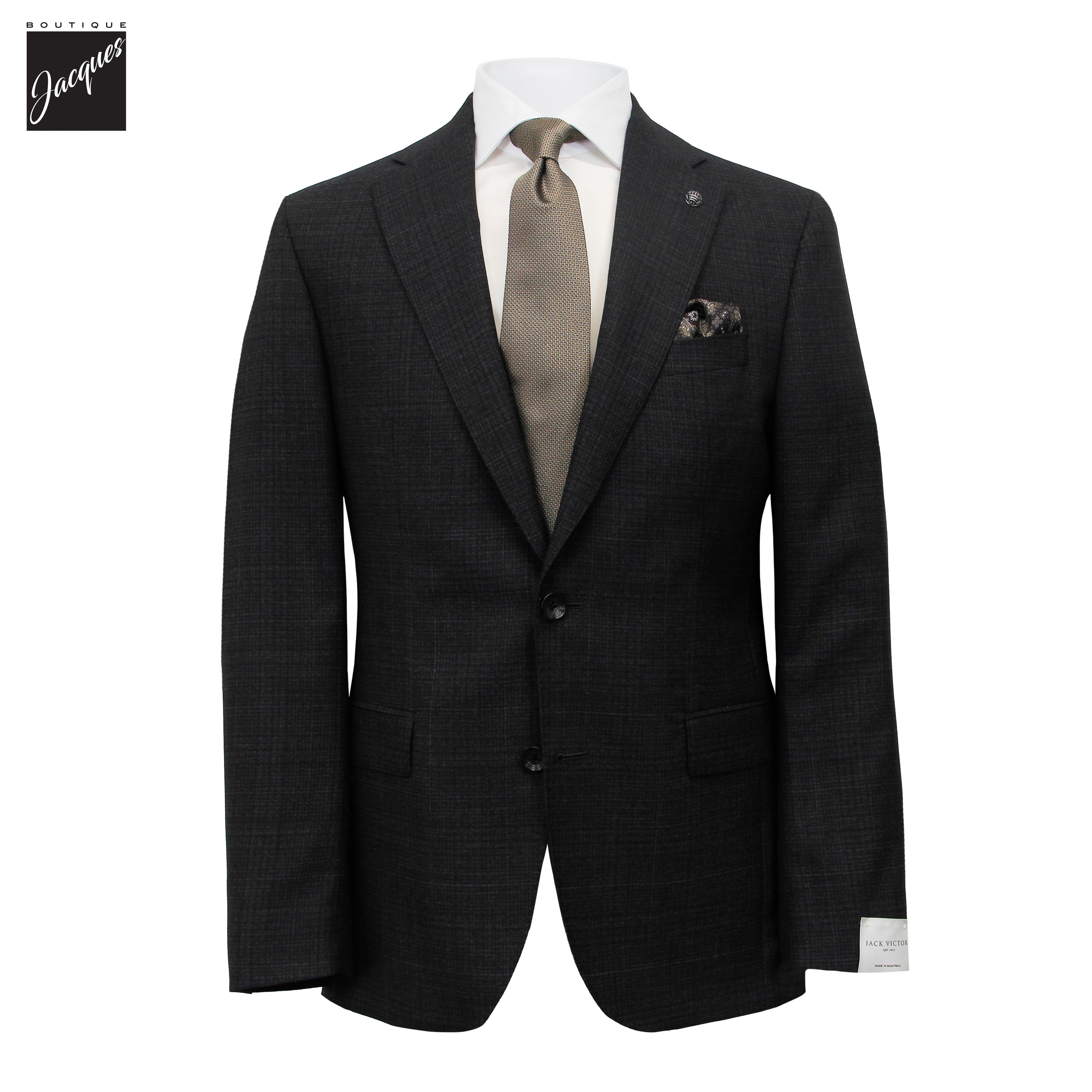
Open any two jackets at the same price and the difference is usually hiding in the chest. A canvassed suit carries a floating layer of canvas between cloth and lining; it moulds to you over the first year the way good shoes do, and the lapel rolls instead of lying flat as a pressed envelope. A fused jacket is glued, and it stays exactly the shape it was on its first day — which is to say, a little lifeless. Fused construction is not a scandal at the right price. Paying canvassed money for a fused jacket is. Pinch the cloth below the buttonhole and feel for the third layer moving between your fingers; it is a thirty-second test that tells you more than the tag will. The charcoal subtle-check Super 110's Esprit ($1,298), cut by Jack Victor a few kilometres from our door, is the suit we reach for when a man says: just pick for me. Charcoal, canvassed, Italian cloth, Montreal make. It is the whole first half of this article on one hanger.
Buy the shoulder, alter the rest
Fit comes last in this article and first in the fitting room. The rule we have repeated since September holds: the shoulder is the one region of a jacket no tailor can honestly fix, so the seam must end where your shoulder does — not a costume-y half inch past it. The collar should sit against your shirt without biting or gaping, and the jacket should close without the buttonhole straining into an X. Everything else — sleeves, waist, trouser seat and hem — our tailors handle in-house, usually inside a week. Too big is a tailoring bill. Too small is a donation.
And when choosing ends and nothing on the rack fits the way you deserve, that is not a failure of shopping; it is where made-to-measure begins. Mid-October is the honest moment for either path — the tailored wall is as deep as it will be all year, and the season's invitations have not started arriving yet. Book a fitting, or simply come stand in front of the mirror with us. Four questions, one suit, no guesswork.