At our counter on Decarie Boulevard, "blazer" has quietly become the word for any jacket with a lapel. A man points at a herringbone sport jacket and calls it a blazer. Another wears his suit jacket over jeans and calls that a blazer too. Nobody corrects anyone, and the afternoon carries on. But the blazer vs. sport jacket question deserves a proper answer, because the three garments that one word confuses — blazer, sport jacket, suit jacket — live by different rules, and wearing one by the rules of another is the single most common mistake we untangle in our fitting room.
Blazer vs. sport jacket vs. suit jacket: what the words mean
A suit jacket is half of something. It was cut from the same bolt of cloth as its trousers, usually a smooth worsted wool, and it was designed to be read together with them — one column of cloth, head to ankle. The cloth is the tell. Fine worsted carries a quiet sheen, and that sheen says, to anyone standing ten feet away, that matching trousers exist somewhere.
A blazer, strictly speaking, is a solid jacket — navy by long tradition — with metal or contrast buttons and a naval ancestry. It lives alone, but it dresses up. It is the most formal jacket a man can wear that is not part of a suit.
A sport jacket was born independent. Texture, pattern, patch pockets, a softer shoulder — everything about it announces that no trousers were ever attached. Its origins are in the country, in cloth that expected weather, which is why it still looks most natural over flannels, corduroy, or dark denim. It is also, if we are honest, most of our wall.
The orphaned suit jacket, settled for good
We have issued this warning in one-line doses all fall. Here is the full argument. A suit jacket worn without its trousers does not become a sport jacket; it becomes evidence. The smooth worsted that looks authoritative above matching trousers looks unfinished above anything else — not casual, incomplete, like a man who left the house mid-thought. The eye reads cloth before it reads cut, and shine over denim is a sentence missing its second half.
The test takes five seconds in your own closet. Hold the sleeve to the window. If the cloth has even a faint sheen and no texture you can feel, it is a suit jacket — leave it with its mate. If your fingers find grain, weave, or softness, it can live alone. The reverse mistake, mercifully, barely exists: a sport jacket never pretends to be a suit. It lacks the ambition, which is its charm.
Where the true blazer went
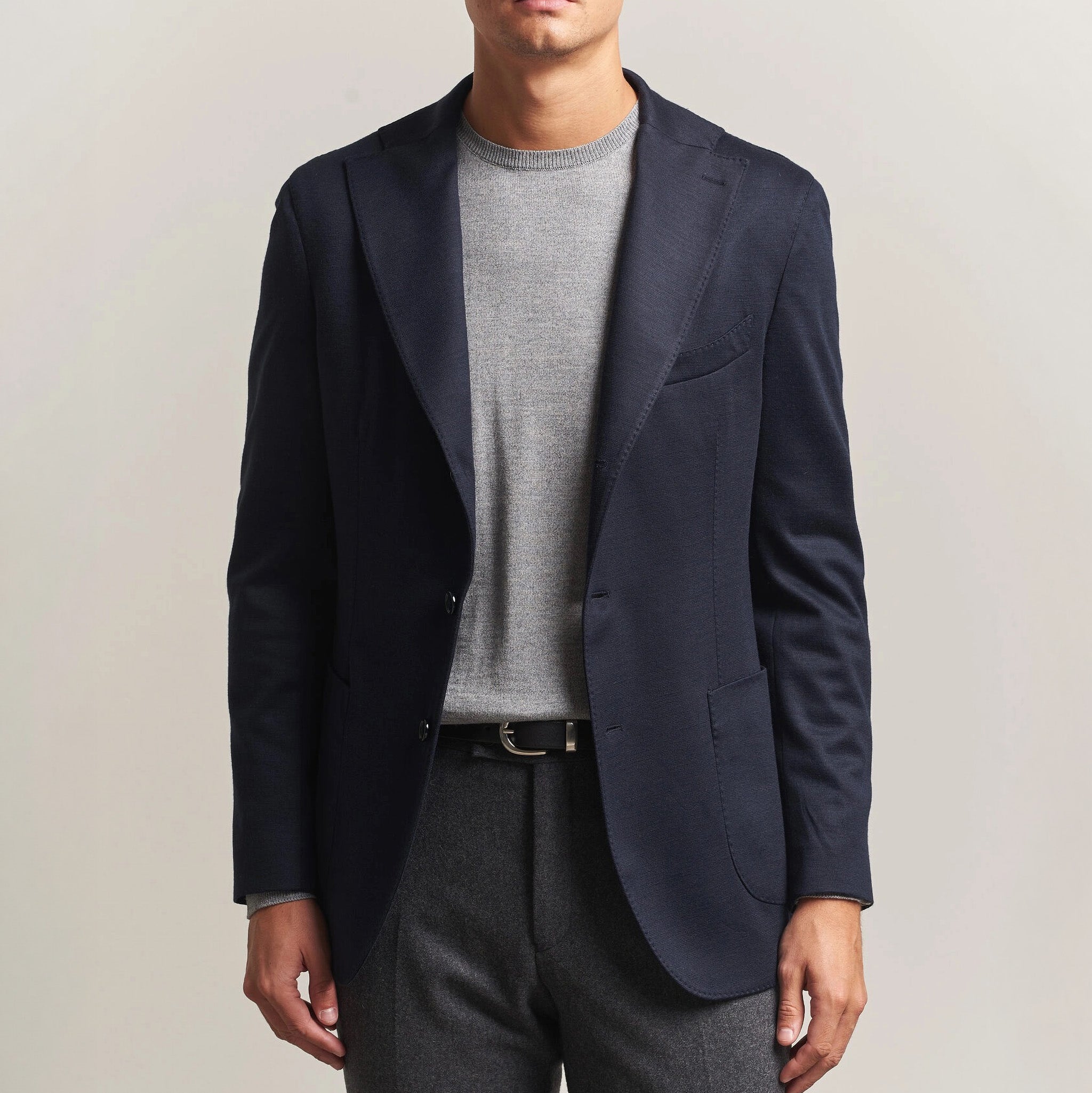
Now the honest report from our own racks: we hardly stock a brass-button blazer anymore. That is not neglect. When Montreal offices went tie-optional, the navy sport jacket simply took the blazer's job. Textured navy — hopsack, jersey, a knitted wool — does everything the old blazer did, without the risk of looking like you misplaced a yacht. Our position, after watching this play out across a decade of fittings: unless you actually sail, buy the navy sport jacket and never think about it again.
The newest version of that argument just arrived from Sweden. Stenströms has dressed our shirt wall for years; this fall, for the first time, we hung their navy wool jersey unconstructed sport jacket ($1,260) beside the Italians. It is a shirtmaker's idea of tailoring — knitted rather than woven, soft through the shoulder, comfortable the way only a house obsessed with how cloth touches skin would insist on. It is, in effect, what the blazer grew up into.
And for the man who wants his navy jacket to say something rather than settle something, Luigi Bianchi's navy windowpane in wool, silk, and linen ($1,795) makes the point from across a room: a pattern is a birth certificate. No suit ever looked like this, and that is precisely the message.
October is the month to sort this out
This is the stretch of the Montreal calendar when the jacket is the coat — the last weeks a man walks out in tailoring alone before the overcoat takes over. Which makes it the right moment to open the closet and run the three tests: feel for texture, check the buttons, ask whether matching trousers exist. Whatever survives the sorting belongs on your shoulders now.
And the orphan — the suit jacket whose trousers wore out years ago? Bring it in. We will tell you honestly whether it can live alone, and most worsted orphans cannot, but we would rather say so across the counter than let the cloth say it across a boardroom. The jacket wall is at full depth this week, our tailors are in the back, and an appointment takes two minutes to book. Three garments, one word. Now you know which is which.