November is the month jeans stop being weekend clothes in Montreal. The suits still come out for the days that demand them, but between the first slush and the last office party, denim does more work in this city than any other garment a man owns. So it is the season we hear one question at the counter on Decarie Boulevard more than any other: are expensive jeans worth it? You are asking because our shelf holds a $300 pair from PAIGE and a $495 pair from Tramarossa, and nothing on either tag explains the gap. The honest answer is sometimes — and we would rather tell you when than let the price do the talking.
What the extra money actually buys
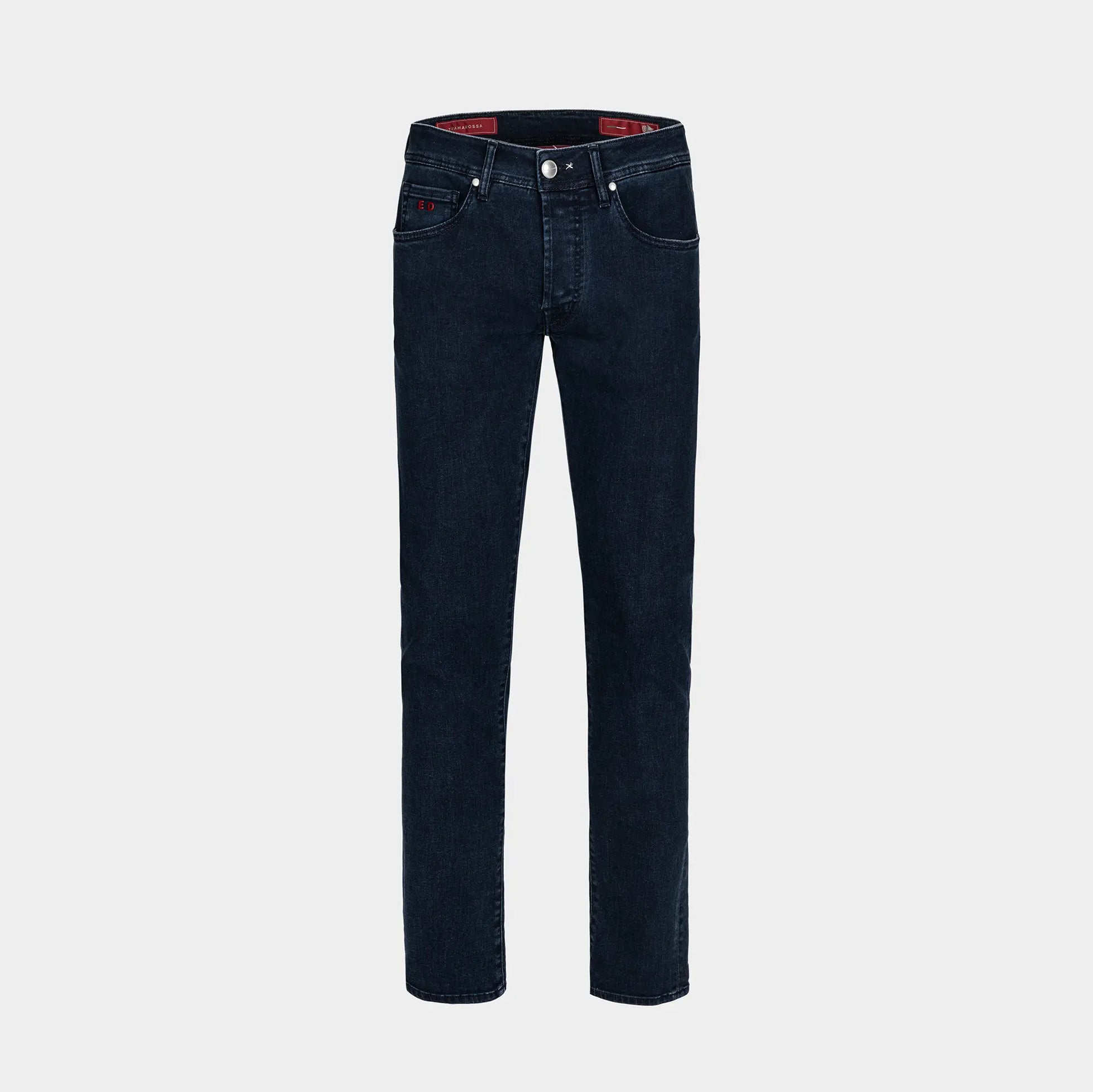
Start with the $495 pair, because it has the most explaining to do. Tramarossa cuts its jeans in Italy, in the Veneto, and treats a five-pocket the way a tailor treats a trouser. Pick up the Michelangelo in blue raw or the soft-dye colours — the dark blue, the coffee brown, the ice grey — and the first thing you notice is the handle of the cloth: a dense super-stretch denim that moves when you sit and, more importantly, moves back. The hardware is finished rather than merely attached. The seat and thigh are shaped, not just sized. These are jeans built on the assumption that a grown man will wear them with a sport jacket, and they hold up their end of that bargain.
The $300 pair is not the lesser argument — it is a different one. PAIGE designs in Los Angeles and built its reputation on fit before fabric. Their Transcend cloth is the point: a knit-like stretch denim that recovers all day, so the knees do not bag by Thursday and the seat does not go slack by four o'clock. The Federal, their straight fit, is the one we reach for most often on men who want denim that behaves for twelve hours and asks nothing in return. It is less dressed than the Tramarossa, and it does not pretend otherwise.
So — are expensive jeans worth it?
Here is where we argue against our own shelf, a little. If you wear jeans twice a month — the Saturday errand, the casual dinner — the $495 pair is a luxury you will not use up, and we would quietly steer you to the PAIGE. A jean earns its price the way a coat does: by the day. But reverse the math for the man whose office went business casual and never came back. If denim is your uniform three or four days a week, the Tramarossa worn a hundred and fifty days a year costs almost nothing per wear, keeps its shape through all of them, and dresses up far enough that one pair covers the client lunch and the school pickup alike. The expensive jean is not a treat. It is workwear for a particular kind of work, and plenty of Montreal careers now qualify. You can see both arguments side by side in our jeans collection.
The five-pocket that is not denim
One more honest wrinkle. Some of the best "jeans" on our shelf contain no denim at all. Tramarossa's soft-dye five-pockets in coffee or off-white, and Alberto's Ceramica five-pockets out of Germany — navy, black, charcoal — borrow the architecture of a jean and the manners of a trouser. The Ceramica cloth has a fine, dry finish that reads from across a boardroom as a dress pant; the pockets and rivets only give the game away up close, which is exactly the point. For the man who finds jeans too casual for his office but a wool trouser too formal for his Tuesday, this middle category is the quiet answer, and it is why our casual trouser wall has grown every year we have been watching this shift.
Whatever you spend, fix the hem
A last opinion, offered free. The most common denim mistake we see in this city is not the wrong brand — it is the right pair worn two inches too long, puddling over a good shoe. Price cannot rescue a bad hem, and a proper one costs a fraction of either pair above. Our tailors hem and adjust jeans in-house, the same as they do a suit trouser, and we would rather alter a $300 jean to perfection than sell you a $495 pair that drags. If you want to settle the question on your own legs — try the Transcend against the Michelangelo, with the jacket you actually wear — book a fitting and give us half an hour. The right answer tends to announce itself in the mirror.