Let us begin with a confession that will surprise nobody who has walked the floor at 6224 Decarie: we do not sell watches. Not one. And yet hardly a week goes by without the question coming up at the fitting mirror — usually while we are pinning a jacket sleeve — of how to wear a watch with a suit. It turns out the answer has less to do with the watch than with the two pieces of cloth on either side of it. Those, we know something about.
The quarter inch that does the work
The old proportion still holds. The jacket sleeve ends at the wrist bone, and a quarter to half inch of shirt cuff shows below it. That sliver of cotton is the frame, and the watch lives inside the frame — under the shirt cuff, not on top of it, not fighting it. Standing at rest, the watch should all but disappear. Reach for a glass, and the cuff slides back just enough to show the time. That small privacy is most of the elegance.
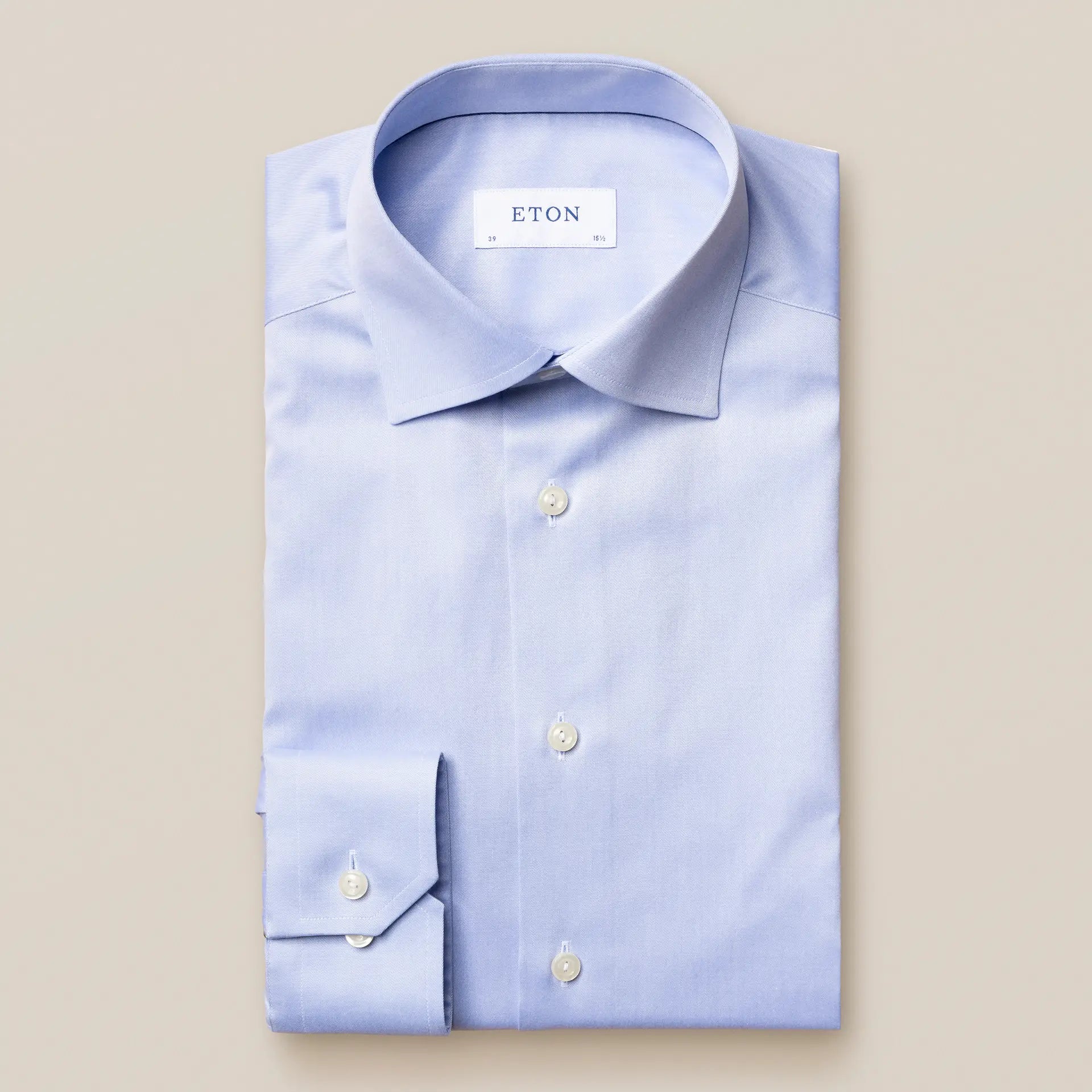
The cuff has to clear the case to do this. When it cannot, one of two things happens, and we see both weekly. Either the cuff perches on the watch and rides up the forearm, which makes a correctly hemmed sleeve read as an inch too short, or the wearer sizes the shirt up to buy room and the collar gapes instead. Neither is necessary. Most of the dress shirts on our wall — ETON’s signature twill among them — close with a two-position button cuff, and moving that button is a five-minute job for our tailor. We do it constantly, and almost nobody asks for it. Ask for it.
One opinion from the bench: thickness is the enemy, not diameter. A wide, flat watch slips under a cuff that a smaller but tall diver’s case will snag every time.
How to wear a watch with a suit, then
Simply, is the honest answer. A thin case and a plain strap — leather in this weather, please, cold steel on a Montreal November wrist is its own punishment — will pass under any cuff we sell and come out only when called for. Checking the time should be a quiet gesture, not an announcement.
The big sports watch is where we are supposed to wag a finger, and we will only half-wag it. Under a tailored sleeve at a board table it fights the cloth, and you will feel it catch on the cuff all day. But if it was your father’s, wear it. Sentiment outranks proportion, and anyone worth impressing knows that.
The smartwatch is a different matter, and we will say the thing out loud: in a meeting, every glance at it reads to the room as somewhere else you would rather be. A watch tells the time; a screen tells the other person they are being timed. Our clients run companies, and the ones who run them most calmly tend to have the quietest wrists. Save the screen for the gym.
As for which wrist — tradition says the one you do not write with, and tradition can keep it. Wear it where you can check it without crossing your arm over a dinner plate.
Bring the watch to your fitting
Here is the practical part, and the part almost everyone skips. When we hem jacket sleeves, or take measurements for a made-to-measure suit, we want the watch you actually wear on the wrist it actually lives on. No two arms are the same length — in forty years of measuring we have met perhaps a handful of symmetrical men — and a watch adds its own small asymmetry on top. A good tailor cuts for it: the watch-side sleeve finishing a touch longer, the shirt cuff cut a touch fuller, so the frame sits correctly on both wrists instead of averaging the two.
This is the sort of detail made-to-measure exists for, and it costs nothing extra. It is also exactly what an alteration appointment is for if your tailored clothing was bought off the rack, here or anywhere else. Book a fitting, wear the watch, and give us the five minutes at the cuff. It is a small thing. But the wrist is where a suit meets the world — it is the part of the tailoring that shakes hands, signs the papers, and pours the wine — and small things are precisely what we are for.