The tie has become a choice rather than a requirement, and that has made choosing one harder, not easier. When every man in the room wore one, a safe navy stripe did the job. Now, putting one on reads as a decision — which means it had better be a good one. With December's invitations starting to land and the holiday calendar filling in, this is the week we hear the question of how to choose a tie more than any other at our counter on Decarie Boulevard. Here is the honest version of what we tell our clients.
Start with the cloth, not the pattern
Most men shop for a tie by pattern. We would ask you to start a step earlier, because the cloth decides how a tie behaves long before the pattern gets a say. Printed silk is smooth, light, and a little glossy — it photographs beautifully and suits a crisp worsted suit. Woven silk twill has more body and knots with a satisfying heft. And then there is grenadine: silk woven on old shuttle looms into an open, almost gauzy texture that reads as a solid from across the room and as something far more interesting from across the table. We stock DION grenadines in navy, black, and deep green for a simple reason — one navy grenadine goes with every suit a man owns. If you own a single tie, our opinion is firm: make it that one.
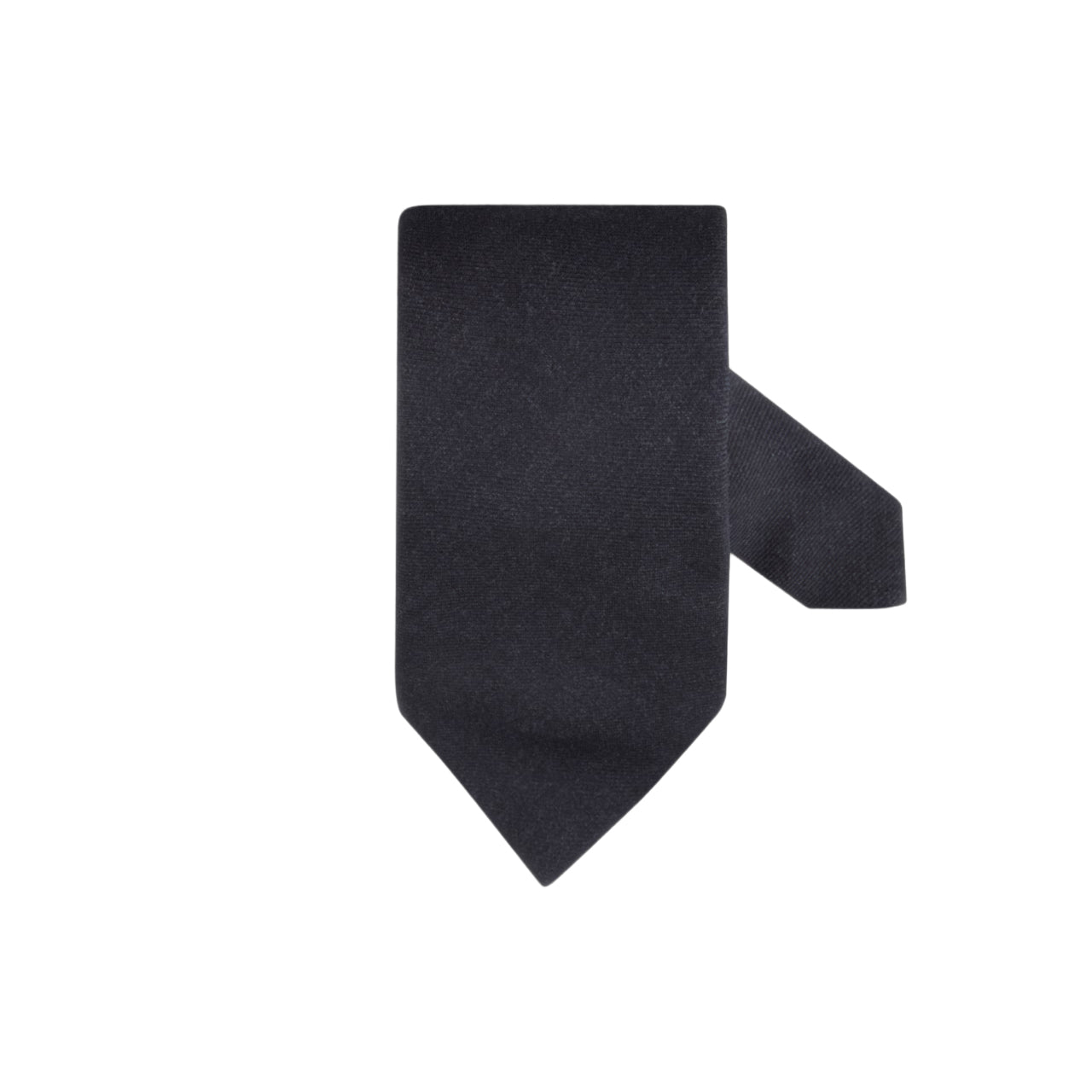
From November to March in Montreal, we would push you one step further, toward wool. A grey wool tie against a flannel trouser or a tweedy jacket is one of the quiet pleasures of winter dressing — Stenströms makes ours, in solid greys that do most of the work themselves. A high-shine satin tie above flannel is like summer shoes in the snow; the cloths disagree about the season, and everyone can feel it even if nobody can name it.
Proportion: the width, the knot, the length
A tie should match the architecture of the jacket it hangs inside. The practical rule: the tie at its widest point should roughly match the width of your lapel. Most of the tailoring we carry sits around eight centimetres at the lapel, and most of our ties sit between seven and a half and eight to match. Skinnier than that and the tie starts arguing with the jacket.
As for the knot — use the four-in-hand. We will say it plainly: the full Windsor is too much knot for almost every collar and almost every man, a wide symmetrical triangle that announces effort. The four-in-hand is smaller, slightly askew, and ties in fifteen seconds, and that touch of asymmetry is precisely what makes it look unforced. Length is simpler still: the tip of the blade should land at your waistband. If your ties never reach it, that is a conversation for a measuring tape, not a mirror.
How to choose a tie you'll actually wear
Here is the three-tie math we give a man rebuilding from zero. First, the navy grenadine. Second, a textured solid — the grey wool above, or a taupe grenadine. Third, and only third, the pattern you genuinely love: a medallion, a dot, an ancient-madder paisley. Most men buy in the reverse order and end up with a drawer of conversation pieces and nothing to wear to the Tuesday meeting.
One more rule, learned from decades of standing between the shirt wall and the tie drawer: let one of them stay quiet. A patterned tie wants a plain or subtly striped shirt; a boldly striped shirt wants a solid tie. When both talk at once, neither gets heard. And if you are weighing two patterns, take the one with the smaller repeat — it holds up better at a boardroom distance.
A word on the season
December in this city is dark worsteds, flannel, and knitwear, and texture is what carries a man through it. It is also, not incidentally, gift season — and a tie remains one of the few pieces of real clothing you can give a man without knowing a single measurement. We set aside no small part of our tie selection every December for exactly this errand, and we are happy to narrow the wall to three honest candidates if you tell us something about the man.
And if the tie is for you, bring the suit — or at least the jacket. Ten minutes in front of our mirror beats an hour of guessing at home. Book a visit, or simply come by the store on Decarie Boulevard. The wall is at its fullest right now, and the four-in-hand lesson is free.